
Headless Shopify: When It Pays Off in 2026
When headless Shopify is worth it in 2026: what Hydrogen and Oxygen are, the costs a build quote leaves out, the SEO work, and the middle options to try first.
 Haroon Ali ShahNovember 20, 2026 · 8 min read
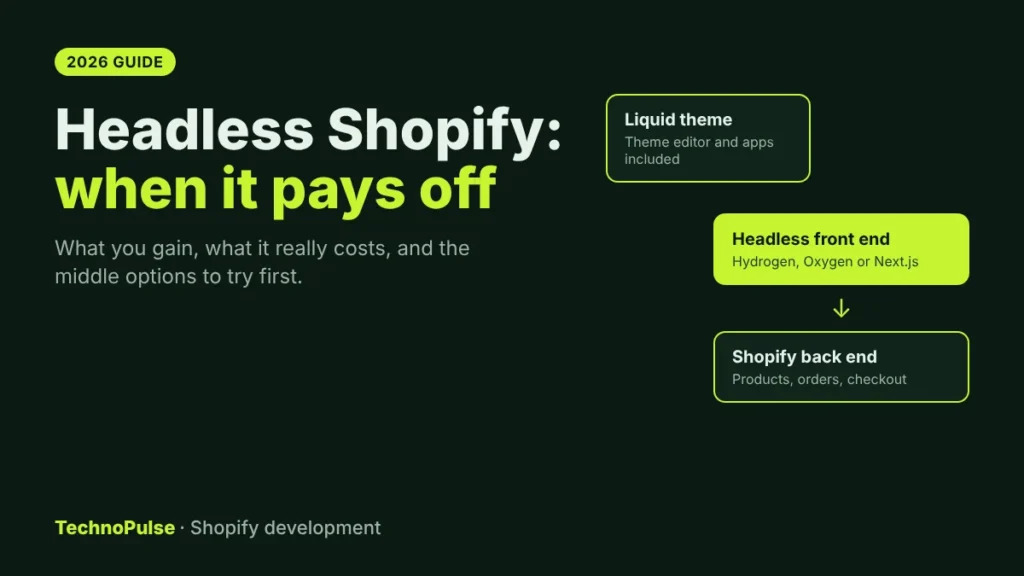
Headless Shopify pays off when your storefront needs something a Liquid theme cannot do well and you have the engineering budget to own a custom front end for years, not just to build it once. For most DTC brands under that bar, a fast, well built Shopify theme gives better returns, because headless trades the theme editor and plug and play apps for flexibility you may never use.
Headless comes up often when brands talk to us about Shopify Plus, usually after someone has seen a beautiful headless site. This guide explains what headless Shopify actually is in 2026, what it costs you beyond the build, the signals that it is worth it, the signals that it is not, and the middle options that get most of the benefit for a fraction of the effort.
What is headless Shopify?
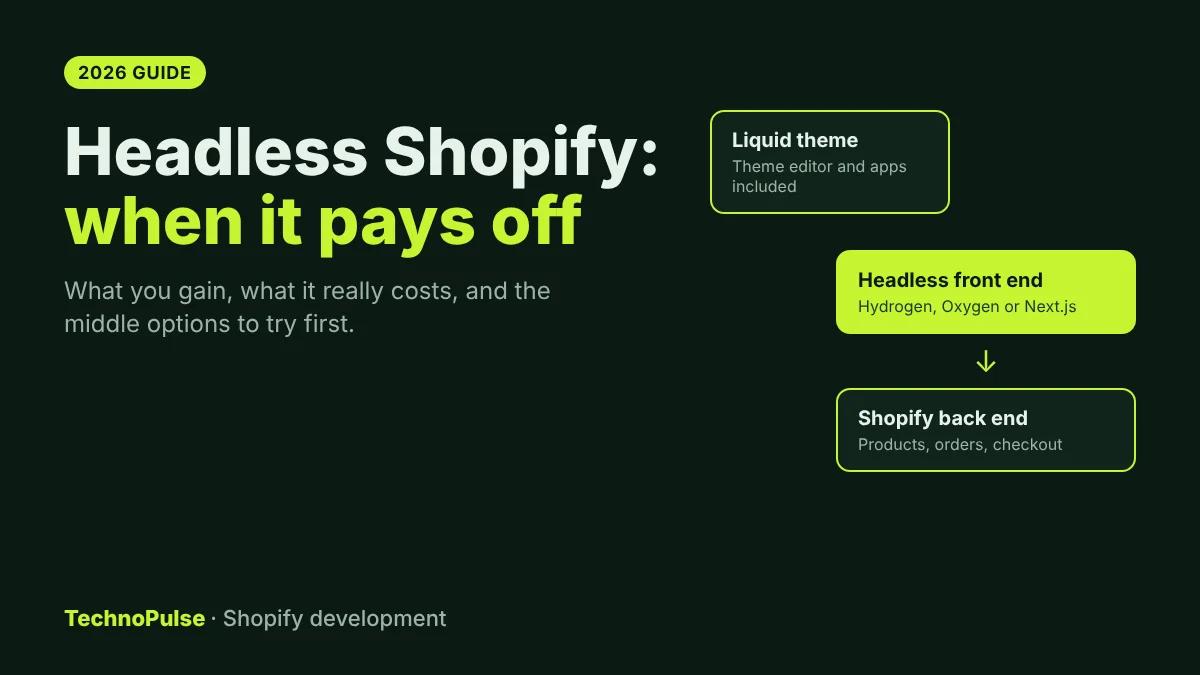
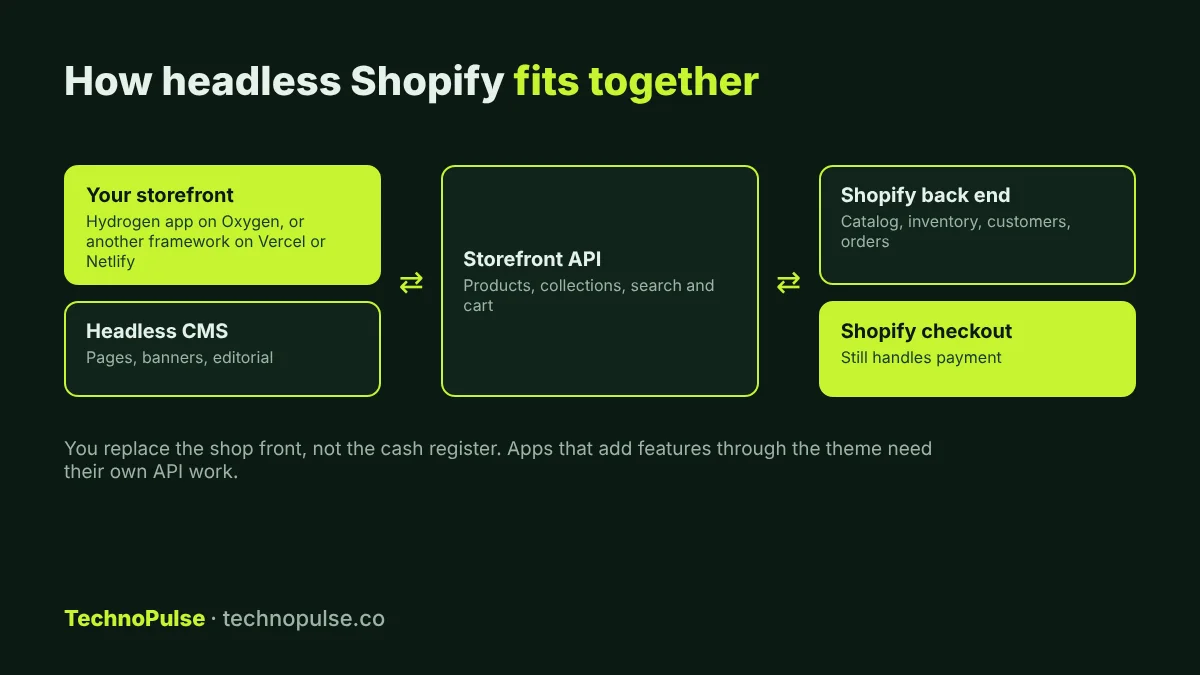
Headless Shopify means Shopify still runs the back end (products, inventory, customers, orders and checkout) while your shop front is a separate application you build and host. Shopify’s own definition is that headless architecture decouples the front end presentation layer from the back end commerce engine (Shopify, headless architecture).
The two parts talk through Shopify’s Storefront API, which serves products, collections, search and the cart and then hands the customer to Shopify checkout (Shopify headless overview). So even a fully headless store still checks out on Shopify. You are replacing the store front, not the cash register.
Hydrogen and Oxygen in plain words
- Hydrogen is Shopify’s own framework for headless stores. According to Shopify’s developer docs, Hydrogen projects are React Router apps preconfigured with Shopify specific features (Hydrogen and Oxygen fundamentals).
- Oxygen is Shopify’s hosting for Hydrogen stores, running at the edge. Shopify states that Oxygen is available at no extra charge on paid Shopify plans, from Starter and Basic up to Plus, and since August 2026 it also works on trial plan stores.
- Other stacks are possible too: Next.js or another framework hosted on Vercel or Netlify, often with a headless CMS for content.
That last point matters: headless is not a Shopify Plus only feature anymore. The real gate is not the plan, it is the team you need to run it.
What you gain with headless
- Full control of the front end. Any layout, any interaction, any URL structure. No fighting a theme’s section limits.
- Content and commerce from several sources. Editorial content from a CMS, products from Shopify, and data from other systems can be merged into one page.
- One commerce back end for many front ends. The same catalog can power a website, an app, kiosks or a second brand site.
- Performance headroom. A well engineered headless front end can be very fast. The word “can” is doing a lot of work there; a badly built one is slower than a good theme.
What headless costs you that the build quote leaves out
The build is the visible cost. The ongoing costs are the ones that hurt:
- The theme editor goes away. On a theme, your marketing team changes a banner or reorders a homepage in minutes. On headless, that only works if someone builds content editing into the stack, usually with a headless CMS. Otherwise every change becomes a developer ticket.
- Apps stop being plug and play. Many Shopify apps add features through the theme. On a headless store those front end pieces do not appear by themselves, so reviews, upsells, loyalty widgets and personalisation each need an API integration and front end code.
- You own the code forever. Framework upgrades, Storefront API version changes, security fixes, hosting and monitoring are now your job. Hydrogen itself moves fast: Shopify already keeps separate docs for the Hydrogen releases from October 2026 onward.
- Longer timelines. A custom theme usually ships in weeks; a headless build usually takes months. Shopify’s own enterprise comparison positions Liquid storefronts for budgets under $1M and timelines under six months, and headless for budgets and timelines above that (Shopify).
- Testing gets harder. Most CRO and A/B testing tools are built for themes. On headless you need tools and tracking set up for your stack, which slows down the experiments that actually grow conversion.
Headless and SEO: what you have to rebuild
A Shopify theme hands you a lot of search basics for free. On a headless store each of these becomes a line in the project plan, and missing one can cost rankings you spent years earning:
- Server rendering. Product and collection pages must arrive as full HTML, not as an empty shell filled in by JavaScript, so search engines and AI crawlers can read them. Hydrogen renders on the server by default; other stacks need it set up.
- Titles, meta descriptions and canonical tags for every template, including filtered collection URLs.
- Structured data for products, reviews, breadcrumbs and your organisation.
- XML sitemaps and robots rules that stay in sync with the catalog.
- Redirects for every old URL. If the URL structure changes, map each old product, collection and blog URL to its new home with a permanent redirect before launch.
- Image handling. Responsive sizes, modern formats and a hero image that is never lazy loaded, so Largest Contentful Paint stays under 2.5 seconds, the threshold Google sets as good (web.dev).
None of this is hard for an experienced team, but it is easy to leave out of a quote. Ask any agency pitching you headless to show exactly how they handle each item, and ask for a crawl of the staging site before launch day.
When headless Shopify pays off
In our experience, headless is worth it when several of these are true at the same time:
- You have a dedicated front end team, in house or on a long term retainer, not a one off build budget.
- Content is a core part of the product, such as a publisher, a brand with heavy editorial, or guides and tools that live next to the catalog.
- You run several storefronts or channels from one catalog: multiple brands, an app and a site, or very different regional experiences.
- You have a specific experience a theme cannot deliver, such as a complex configurator or a highly interactive product builder, and you can name the revenue it should drive.
- Your current theme is already fast and well optimised, and you have hit a ceiling that is caused by the platform, not by apps or images.
When headless is the wrong move
- The main reason is “our site is slow”. Most slow Shopify stores are slow because of apps, scripts and heavy images, and a speed clean up on the existing theme fixes that for a fraction of the cost.
- Your marketing team needs to ship landing pages and promotions weekly without developers.
- You rely on many front end apps and do not want to rebuild each one.
- The budget covers the build but not two to three years of upkeep.
- You want to start running A/B tests next month.
The middle options most brands should try first
Between a stock theme and full headless there is a lot of room:
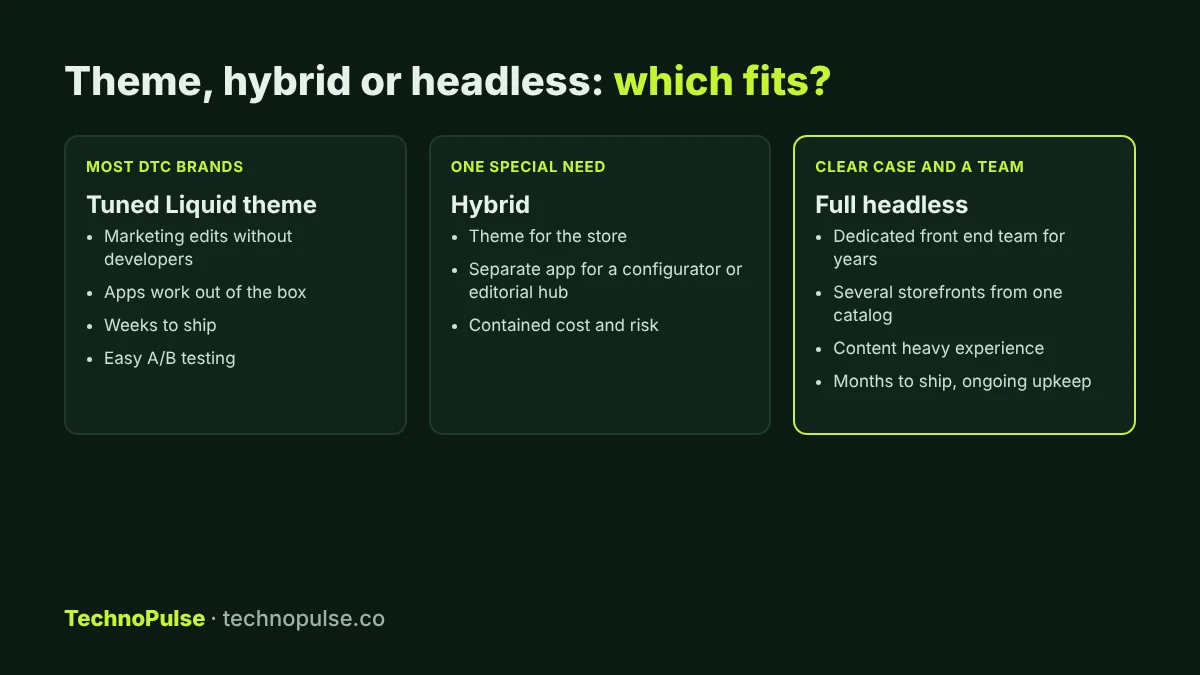
- A custom or heavily tuned Liquid theme. Custom sections, metafields and metaobjects cover most “we need something unique” requests while keeping the theme editor and apps. This is the core of our Shopify store development work.
- Headless for one part of the site. Keep the store on a theme and build only the piece that needs it, such as a product configurator or an editorial hub, as a separate app.
- Fix speed and conversion first. Removing unused apps, getting the hero image to load first and simplifying the product page usually beat a replatform for return on spend. Our Shopify speed optimization service and hero section guide are good starting points.
A simple way to decide
Answer these five questions honestly:
- What exact customer experience will headless enable that our theme cannot, and what revenue do we expect from it?
- Who will maintain the front end in year two and year three, and what will that cost per year?
- Which of our current apps touch the storefront, and what does rebuilding each one cost?
- How will marketing publish pages and promotions without a developer?
- Have we already removed the cheaper causes of slow speed and low conversion?
If you cannot answer the first two with numbers, stay on a theme for now. If you are also weighing a plan upgrade, our guide on Shopify vs Shopify Plus covers what Plus adds and when it is worth it.
How we approach headless projects
TechnoPulse is a Shopify Partner and Klaviyo Partner, and we have helped 200+ DTC brands since 2021. We build headless storefronts when the case is clear, and we talk brands out of it when a better theme would do the job. Our headless commerce development page explains how we scope and run those builds.
Not sure which side of the line you are on? Ask for a free Shopify store audit. We will look at your speed, apps and conversion data and tell you whether headless would actually move revenue, or whether the fix is closer to home.
Choosing a platform from scratch rather than going headless on Shopify? Our guide on how to choose an ecommerce platform for long term growth covers the questions to ask first. And if you are weighing a custom theme against a template, see why custom ecommerce development outperforms template stores.
FAQ
Is headless Shopify only for Shopify Plus?
No. Shopify says Oxygen hosting for Hydrogen storefronts is available at no extra charge on paid plans from Starter up to Plus, and on trial stores since August 2026. In practice headless suits larger brands because of the engineering cost, not the plan.
Does a headless Shopify store still use Shopify checkout?
Yes. The Storefront API handles products, collections, search and the cart, then hands customers to Shopify checkout, so payments and checkout still run on Shopify.
Is headless Shopify better for SEO?
Not automatically. Headless gives full control of URLs and markup, but you must build server rendering, metadata, structured data, sitemaps and redirects yourself. A well built theme already handles most of that.
Do Shopify apps work on a headless store?
Back end apps that work through the Shopify admin usually keep working. Apps that add features to the storefront through the theme need an API integration and custom front end code on a headless store.

Founder and CEO of TechnoPulse. Leads Shopify development, CRO and growth strategy for DTC brands in the US, Europe and Australia.
More about Haroon