
How Much Does Shopify CRO Cost in 2026?
What Shopify CRO really costs in 2026: vendor tool prices, published agency rates, traffic minimums for testing and a payback formula to set your budget.
 Haroon Ali ShahNovember 13, 2026 · 9 min read
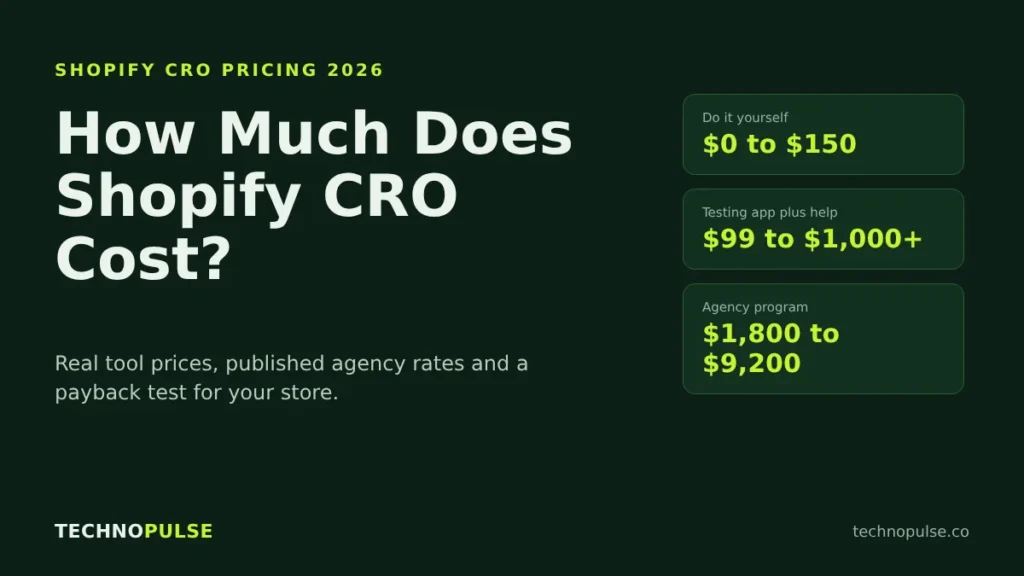
Shopify CRO in 2026 costs anywhere from $0 a month, using Shopify’s own Rollouts and the free Microsoft Clarity, to about $1,800 to $9,200 a month for agencies that publish their prices, with testing apps such as Shoplift adding $99 to $999 a month. The right spend for your store depends less on any price list and more on two things: whether your traffic can support real testing, and what a single conversion point is worth to you in gross profit.
Most pages that answer this question are written by agencies quoting their own ranges with no source. This guide does it differently. Every tool price below comes from the vendor’s own pricing page, every agency figure comes from an agency that publishes its rates, and the payback section gives you a formula you can run on your own numbers before you sign anything.
The short answer: three CRO budget levels
Almost every Shopify brand lands in one of three levels. The level you belong in is set by traffic and margin, not by ambition.
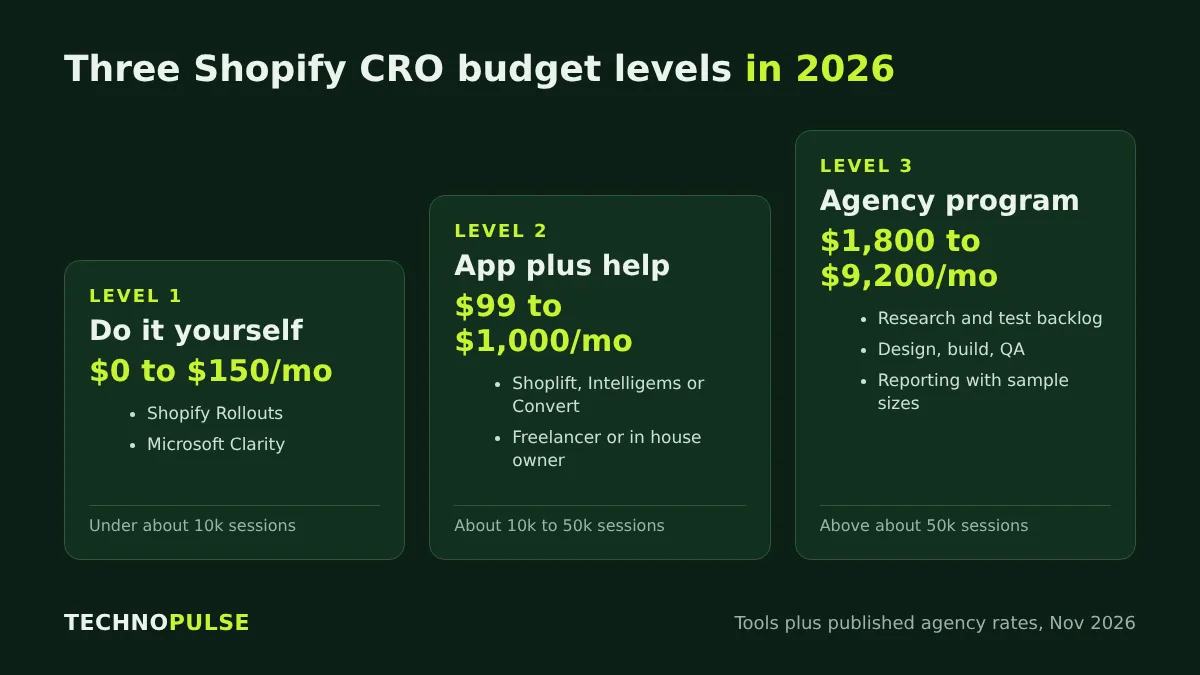
| Level | Typical monthly cost | What you get | Best for |
|---|---|---|---|
| 1. Do it yourself | $0 to about $150 in tools | Shopify Rollouts, Microsoft Clarity, a free or entry heatmap plan, your own time | Stores too small to reach test significance, early brands fixing obvious leaks |
| 2. Testing app plus help | $99 to $1,000 in tools, plus design and development hours | Shoplift, Intelligems or Convert, with a freelancer or in house marketer running tests | Stores with steady traffic and someone who can own a roadmap |
| 3. Agency program | About $1,800 to $9,200 a month in published retainers, often with a setup fee | Research, test backlog, design, build, QA and reporting | Stores with enough traffic to run several clean tests a month |
If you are not sure which level fits, read the traffic section below first. Spending at level 3 with level 1 traffic is the most common way brands waste money on CRO.
What you are actually paying for
A CRO budget always splits into three parts, and quotes that do not separate them are hard to compare.
- Tools. Testing software, session recordings, heatmaps and surveys. This is the cheapest part and the easiest to price.
- Implementation. Design and Shopify theme development to build each variant, plus quality checks on mobile, across browsers and through checkout. On most programs this is where the hours go.
- Strategy and research. Analytics review, customer research, deciding what to test, and reading results honestly. This is what separates a program that compounds from one that runs random button color tests.
When you compare quotes, ask each provider how many hours go to each part and how many tests per month that buys. A cheap retainer that only covers tools and reporting is not a CRO program.
2026 tool prices for Shopify CRO
These are the published prices on each vendor’s own pricing page as of November 2026. Prices change, so check the linked page before you buy.
| Tool | What it does | Published price |
|---|---|---|
| Shopify Rollouts | Schedule theme changes and run theme experiments inside Shopify | No separate fee listed. Rollouts need the Basic plan or higher; experiments need the Grow plan or higher |
| Microsoft Clarity | Session recordings and heatmaps | Free, with no traffic limit |
| Contentsquare (formerly Hotjar plans) | Heatmaps, recordings, surveys | Free plan up to 200,000 sessions with limited replay; Growth from $39 a month |
| Lucky Orange | Recordings, heatmaps, chat | $32 a month (3,500 sessions) up to $839 a month (300,000 sessions) |
| Shoplift | Shopify native A/B testing | Core $99, Advanced $399, Pro $999 a month, priced by monthly visitors |
| Intelligems | Price, shipping, offer and content tests | From $69 a month at the lowest order tier; Unlimited plan quoted separately |
| Convert | General A/B testing platform | Growth $399 and Pro $599 a month billed monthly, each with 100,000 tested users |
| VWO | General A/B testing platform | No public prices; demo required |
Two things stand out. First, a small store can now get session recordings and basic theme experiments for nothing beyond its Shopify plan, using Shopify Rollouts and Microsoft Clarity. Second, Shopify’s native experiments have limits. They cannot test Liquid template changes or vintage themes, so most stores still need a dedicated app once they test beyond theme settings and sections.
What CRO agencies charge in 2026
Most agency price ranges you will read online are estimates with no source. A few agencies do publish their own rates, and they give you a fair anchor:
- WebFX lists CRO plans with a setup fee of $3,600 and $1,800 a month at the entry level, rising to $9,200 setup and $9,200 a month for its enterprise plan.
- Darkroom states that its CRO program begins at $5,250 a month, covering audit, test backlog, design and build. It also says brands under roughly 8,000 to 10,000 monthly sessions on the pages being tested will struggle to justify a testing program.
- GoGoChimp, a UK agency, lists a Growth plan at £2,500 a month with a three month minimum and a requirement of 10,000 or more monthly visitors on the tested page, and a Scale plan at £5,000 a month.
Notice the pattern. Agencies that publish prices also publish traffic minimums. That is a good sign. A provider who will sell you a testing retainer at any traffic level is selling hours, not results.
Common pricing models
- Monthly retainer. The most common model. You pay for a set number of tests or hours each month, usually with a minimum term of three to six months.
- Audit or sprint. A one off project that finds and ranks the biggest leaks, then hands you a fix list. Good for stores that are not ready for testing yet.
- Performance based. Fees tied to measured lift. Read the attribution terms closely, because who decides what counts as lift matters more than the percentage.
Does your store have enough traffic to test?
This is the question that decides your budget. An A/B test needs enough conversions in each variant to tell a real change from noise.
- CXL’s guidance is to ignore results with fewer than 250 to 350 conversions per variation and to run tests for at least one, and better two, full business cycles. Its worked example shows a store with a 3 percent conversion rate needs 51,486 visitors per variation to detect a 10 percent relative lift (CXL).
- Most tests do not win. Optimizely reports that only 12 percent of experiments win on their primary metric (Optimizely).
Put those together and the math is plain. If a page gets 20,000 sessions a month at a 2 percent conversion rate, that is about 400 orders a month in total, or about 200 per variant in a two way test. One clean test on that page could take more than a month. Paying for “four tests a month” on that traffic buys you four inconclusive tests.
If you are below the threshold, your money goes further on research and direct fixes: speed, mobile layout, product page clarity, shipping cost visibility and checkout trust. Our Shopify CRO checklist lists 30 of those fixes, and the product page optimization guide covers the page that usually leaks the most.
The payback math: will CRO pay for itself?
Before you pick a level, run this test on your own numbers. It takes five minutes.
- Find your baseline. Monthly sessions, conversion rate and average order value from Shopify Analytics. If you are unsure what a normal rate looks like, see what a good Shopify conversion rate is.
- Pick a realistic lift. Use a cautious relative lift, such as 5 to 10 percent over six months, not the best case from a sales deck.
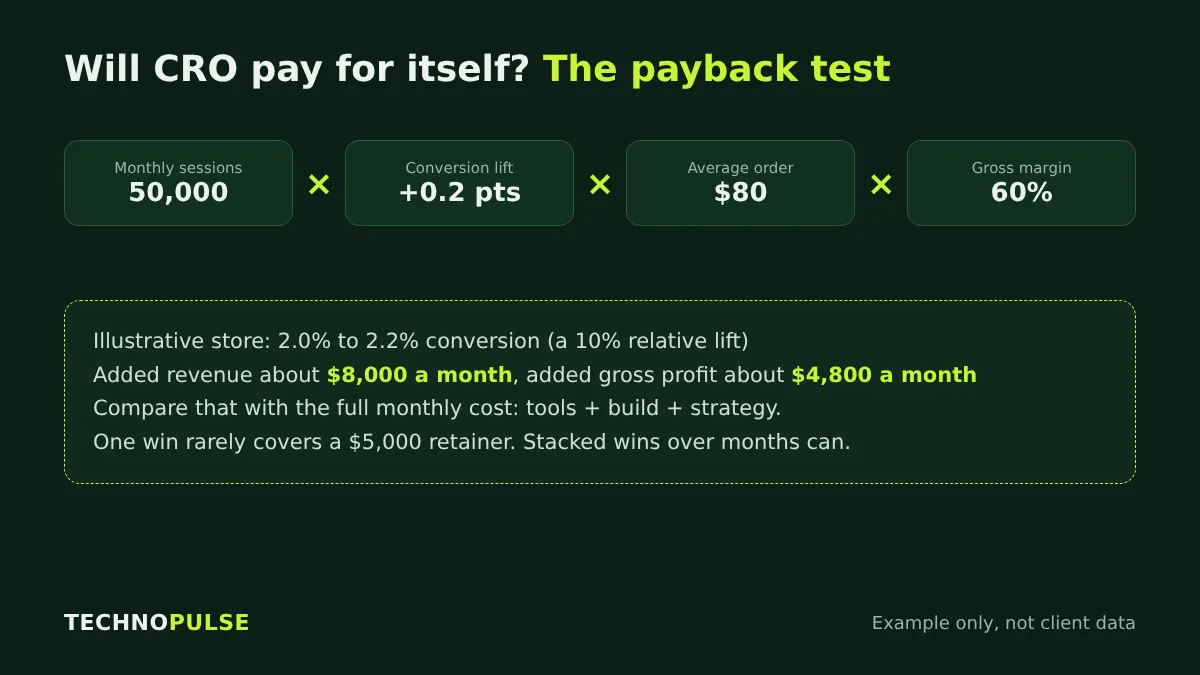
- Convert lift to gross profit. Added orders times average order value times gross margin.
- Compare with the monthly cost. Tools plus implementation plus strategy.
Here is an illustrative example, not client data. A store with 50,000 sessions a month, a 2 percent conversion rate and an $80 average order value makes about $80,000 a month. A 10 percent relative lift takes the rate to 2.2 percent and adds about $8,000 in monthly revenue. At a 60 percent gross margin that is about $4,800 in added gross profit each month.
Against a $5,000 a month retainer, that one lift does not pay back on its own. It pays back when wins stack over several months and keep earning after the test ends. That is why minimum terms exist, and why a store at half that traffic should start at level 1 or 2.
How to choose your CRO budget by stage
Under about 10,000 monthly sessions
Stay at level 1. Install Clarity, watch 30 to 50 recordings of sessions that reached the cart and left, fix what you see, and use Shopify Rollouts to schedule changes. A one off audit can make sense here because it gives you a ranked fix list without a monthly commitment.
About 10,000 to 50,000 monthly sessions
Level 2 usually fits. A testing app such as Shoplift or Intelligems, plus a person who owns the roadmap, lets you test high traffic pages like the home page, collections and top product pages. Keep shipping fixes that do not need a test.
Above about 50,000 monthly sessions
This is where an agency program earns its fee, because you can run several clean tests a month and the gross profit from each point of conversion is large enough to cover the retainer. Follow a structured process like the one in the seven steps of conversion optimization.
Red flags when you buy CRO
- No question about your traffic or conversion volume before a price is quoted.
- Promises of a fixed conversion lift before any research.
- Tests called after a few days, or results reported without sample sizes.
- Every test is a color or copy tweak with no research behind it.
- No access to the testing tool or raw results for you.
How we approach Shopify CRO at TechnoPulse
We start with an audit, because it tells both of us which level your store belongs in before you spend on a retainer. We have helped 200+ DTC brands since 2021, hold a 5.0 rating on Google from 40+ client reviews, and are a Shopify Partner and Klaviyo Partner. For DOD Outdoors, a camping gear brand, we tightened the product pages; online sales have grown 5.8x since 2023 and conversion rose 49 percent in year one (read the case study).
If you want to know what CRO should cost for your store, see our Shopify CRO agency services or book a free store audit. We will tell you honestly if your traffic is better served by fixes than by a testing program.
FAQ
How much does CRO cost for a Shopify store?
Between $0 and about $150 a month in tools if you do it yourself, roughly $99 to $1,000 a month in tools plus hours if you run tests with an app, and about $1,800 to $9,200 a month for agencies that publish their retainers. Traffic decides which level makes sense.
Is CRO worth it for a small Shopify store?
Fixes are worth it at any size. Formal A/B testing usually is not until a page gets enough traffic to reach a few hundred conversions per variant within a few weeks. Below that, spend on research and direct fixes.
Does Shopify have free A/B testing?
Shopify Rollouts lets you schedule theme changes on the Basic plan or higher, and run theme experiments on the Grow plan or higher, with no separate fee listed. It cannot test Liquid template changes or vintage themes.
How long before CRO pays back?
Plan on several months. Most single tests lose or are flat, so payback comes from wins stacking over time. Run the payback formula above with a cautious lift before you commit.
What should a CRO agency include in its fee?
Research, a ranked test backlog, design, Shopify development, QA, and reporting with sample sizes. Ask how many tests per month the fee buys and who owns the testing tool account.

Founder and CEO of TechnoPulse. Leads Shopify development, CRO and growth strategy for DTC brands in the US, Europe and Australia.
More about Haroon